Roland DG believes that taking environmental considerations into account and reducing resource consumption in product development and business promotion is a responsibility entrusted to the Company as it works toward a sustainable society. The Company strives to conserve energy and resources at every stage of the product lifecycle—from design and development to transportation, use, and disposal—as well as through the transformation of its business portfolio and business model, thereby contributing to the realization of a low-carbon, recycling-oriented society.
Roland DG's products are used in countless day-to-day operations, and as such they are designed and developed with energy-efficient operation and reduced actual power consumption relative to productivity in mind. All Roland DG printers feature sleep mode, which is designed to minimize power consumption when in standby. Roland DG is also expanding its lineup of printers that use UV inks, which consume less power during printing than low-solvent inks and water-based resin inks and contribute to reducing GHG emissions. The Company is working to reduce energy consumption and carbon emissions across its entire product portfolio without sacrificing the properties or productivity of each ink or product.
To continuously improve the resource efficiency of its products, targets for reducing product weight and the number of parts are set during the planning stage, and progress toward these targets is monitored throughout the development process. Roland DG incorporates a platform concept into the design and development of its products, reflecting customer needs by building on a common basic design that forms the foundation of its product lineup, thereby achieving both development efficiency and diversity in its product range. At the basic design stage, it is possible to incorporate sustainability considerations such as inventory efficiency through component standardization and modularization, efficient use of resources through a reduction in the number of components, and the facilitation of component reuse and recycling. The Company plans to further develop this approach in the future.
Roland DG is advancing efforts to reduce environmental impact by transforming both its business portfolio and its business model. The Company's VersaSTUDIO series in the Digital Fabrication business features compact desktop printers, cutting machines, and 3D manufacturing products designed for greater energy and resource efficiency compared to conventional large-format commercial inkjet printers. Guided by this approach to reducing environmental impact, the Company strives to reduce GHG emissions for society as a whole. The Company will further refine its traditionally strong concepts of "compactness," "ease of operation," and "SOHO/hobby applications," aiming to minimize environmental impact compared with large-format commercial inkjet printers, which serve as the baseline.
The Company's expanding connected services leverage IoT technology to monitor product usage and equipment status, enabling the timely and efficient provision of necessary maintenance and repair parts, thereby contributing to longer product lifespans and reduced waste. Based on the data obtained, the Company will explore opportunities to create various forms of environmental added value, including optimizing the ordering, production, and inventory of various parts, inks, and other items; reviewing energy and resource efficiency; and leveraging these insights to promote a circular economy.
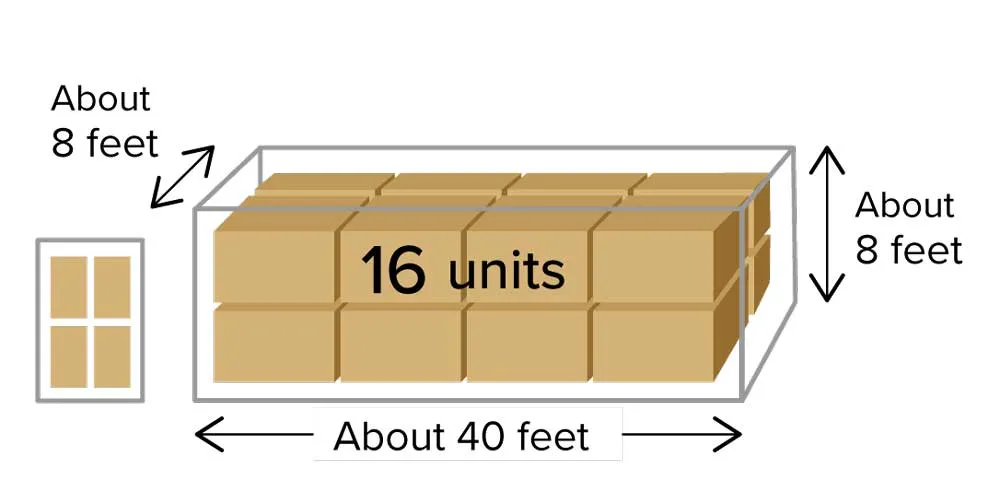
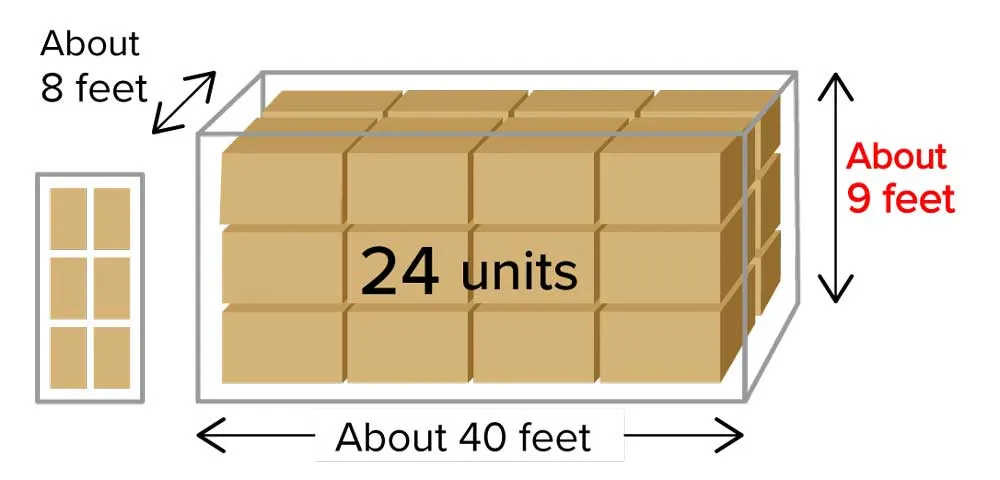
Roland DG reduces both the number of transport containers and GHG emissions by designing product packaging sizes to be optimal for loading into containers for transport by ship, and by using vanning software that optimizes the loading of cargo of different shapes and dimensions from the perspective of loading efficiency. Reducing the number of containers leads to a reduction in the total number of driver trips required and the total distance traveled in truck transport, which also contributes to solving social issues such as long working hours for drivers and reduced transport capacity due to driver shortages.
40-foot container

40-foot High Cube container
The inside of inkjet heads needs to be cleaned regularly using fresh ink so that inkjet printers can continue to be used in optimal condition. Roland DG continuously improves the operating sequence of its inkjet printers to minimize the amount of waste ink generated during cleaning.
Roland DG uses screws rather than welding to join printer chassis wherever possible. This design allows for easy disassembly, ensuring high maintainability and recyclability.
Since 2015, Roland DG has been adopting environmentally friendly pouch-type ink cartridges and transitioning away from plastic cartridges. These pouch-type cartridges are more than 30% lighter per ml of ink than plastic cartridges. This reduction in weight helps cut down CO2 emissions during transportation, and the cartridges are also easier to sort and dispose of after use, significantly reducing the amount of waste.
In 2023, from the perspective of promoting resource circulation for plastics, Roland DG launched paper-based ink cartridges to gradually replace plastic cartridges. These paper cartridges use 82% less plastic than conventional plastic cartridges and help reduce CO2 emissions and address the issue of plastic waste.
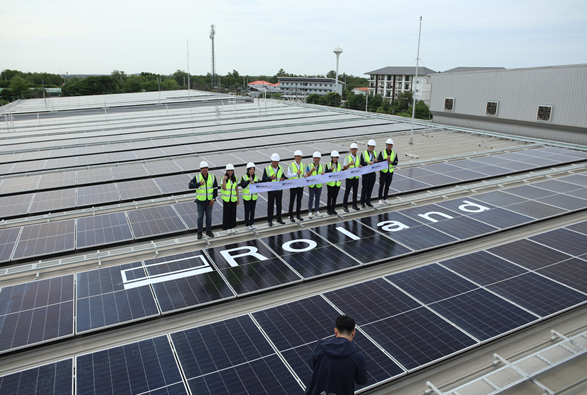
Launch of a solar power generation system at a Thai manufacturing subsidiary
Roland Digital Group (Thailand) Ltd. (DGT), Roland DG's manufacturing subsidiary in Thailand, installed a solar power generation system on the roof of its factory building and, after obtaining approval from the relevant local authorities, began operating the system in July 2025.
In Thailand, the increased adoption of renewable energy and the reduction of GHG emissions are being promoted under the national energy plan. In light of these policy trends, DGT installed the system with the objective of reducing environmental impact through the use of renewable energy.
The system has a power generation capacity of 500 kWp, equivalent to approximately 30% of the electricity used by DGT. This is expected to reduce CO2 emissions by up to 249 metric tons per year.
The Roland DG Group will continue to improve energy efficiency and expand the use of renewable energy across its sites, thereby helping to address climate change and realize a sustainable society.